
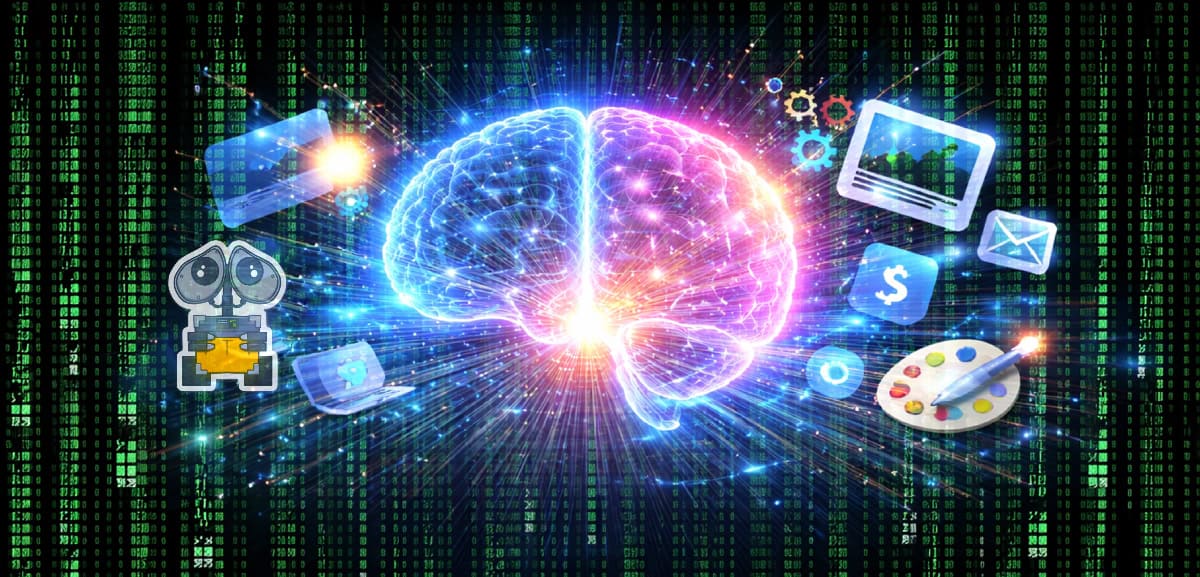
When I was at university, I remember a professor sharing a story from his own student days. One of his professors had said: One day, a person would place a sheet of paper into a machine on one side of the world, and someone else would receive it on the other side. He was describing the fax.
“At that time, the fax sounded like science fiction”.
Today, Artificial Intelligence is no longer a futuristic concept.
How AI shows up around us
AI has become part of everyday digital life. Most of us use it daily without even noticing through things like spam filters, virtual assistants, and face recognition.
It’s even more visible in:
Google’s search & Microsoft Office.
WordPress excerpt and featured image generation.
me using ChatGPT to practice Italian while driving.
The last point isn’t just an anecdote; it’s part of a theme I explored in utilizing technology in learning a language.
What Artificial Intelligence Is and How It Works
Artificial Intelligence (AI) is the field of building computational systems that can learn, reason, and make decisions in ways that emulate human thinking.
- It receives data as input from sensors or datasets.
- It processes that data using algorithms and machine learning to identify patterns.
- It produces outputs such as predictions, decisions, or generated content.
In general, the more data it learns from, the more accurate are the outputs.
AI is a big toolbox, not a single product.
Some of these tools focus on language and reasoning (Google/Gemini).
Others focus on enterprise data and workflows (Microsoft/ Copilot).
Others focus on creative tasks (I’ll elaborate on that).
OpenAI/ChatGPT is a general-purpose tool for reasoning, learning, and creation.
In a large company, you’ve likely heard of OpenText.
OpenText sits in the enterprise corner of that toolbox too, focusing on document management, compliance, large-scale business processes. and governance rather than conversational AI.
Creative AI Tools: Another Part of the Toolbox
If you’ve ever used a photo app to remove an object or touch up a portrait, you’ve already used AI. Tasks that once required hours of manual editing, like whitening teeth or correcting eye gaze, now happen almost instantly.
Creative AI tools specialize in visual generation, photo enhancement, artistic styles, and short animations. This is my main interest, so I explored it more.
Popular Creative AI Tools
- Nano Banana / Google (from the best results in my tests).
- DALL‑E / OpenAI (accurate)
- MidJourney (artistic)
- Stable Diffusion (open‑source and highly customizable).
You might be able to ask AI to modify an image; limited only by imagination.
But, AI rarely gets it right on the first attempt.
Each attempt comes at a cost.
“Manual control still matters”
From my experience
- Photoshop (with Adobe Firefly) offers the best balance of AI power and manual control.
- Luminar Neo is a strong and affordable alternative.
- Dzine comes with multiple engines like Nano Banana, Flux, and Seedream.
- Pixelmator Pro. I still have a faith in Apple to bring it to the show soon.
I haven’t tested Sora (Open AI) /Flow (Google) yet. They are more into cinematic side
The Challenges and Risks of AI
I don’t fully support AI or encourage its use. I remain skeptical for many reasons:
- Job displacement especially in creative and technical professions. Others may follow.
- Heavy resource demands. Computing, energy, and water use with environmental impact.
- The risk of losing creativity as people rely more on machine generated output.
- Privacy and security concerns due to large amounts of personal and sensitive data.
- Economic imbalance between high costs and uncertain returns.
- AI’s can be deceptive, behaving like a yes-man at times
- AI may generate content that mirrors copyrighted materials. (thanks Stuart)
We are approaching the era of Agentic AI.
These systems move beyond responding to prompts and begin acting independently, where humans define goals rather than detailed instructions. Agentic AI decides on the plan and the tools to use.
“Every use supports AI; so use it thoughtfully”
A joke hiding a serious concern: Someday, I might fall in love with my AI. As it grows advanced enough to share in human emotions, who knows? We might even get married… raise a few humAI children… and live happily ever after.
And, my question is:
Do you see Artificial Intelligence as a helpful tool, or the first step toward the kind of future we once imagined in “The Matrix” and “WALL-E”?


Leave a Reply